A Modern Workplace Ergonomics Strategy: Delivering High-Performance Environments and Eliminating Bureaucracy
In the modern corporate landscape, a successful workplace ergonomic strategy isn’t defined by the thickness of a safety manual or a “check box” proving that employees have received some type of online ergonomic training.
True corporate ergonomic excellence is measured by operational efficiency, resource optimization, the promotion of employee goodwill, all of which leads to injury prevention.
The Invisible Barrier: Why Most Ergonomics Programs Underperform
Most corporate ergonomic programs don’t fail; they become expensive, low-yield administrative burdens. Pacific Ergonomics has found that many of our clients have a process prior to working with us, where 6 to 8 stakeholders, including HR, Procurement, IT, Facilities, EHS, and department managers, all spend hours of time on a single person’s assessment. Also typically these processes takes months of time for employees to get help. This leaves employees who are growing in discomfort feeling uncared for, not as productive and with a heighted injury risk.
When a company is structured this way, the program becomes an expensive and ineffective bottleneck. When implementing even the simplest change like an ergonomic chair that fits their body for a single employees takes 3 to 6 months with 8 people involved, this creates a “marginal” program. An ergonomic program “technically” exists, but it fails to support the employee when they actually need it.
In our experience, this lack of speed makes employees feel unsupported and disgruntled, leading to higher turnover and a negative workplace culture.
The Real Cost of Friction: A Leadership Perspective on Workplace Ergonomic Strategy
Chief People Officers and COOs are realizing that bureaucratic ergonomic programs without proper systems, process and tools are a drain on their most valuable resources.
Think about the absurdity: a physical solution such as a customized ergonomic chair, keyboard, or monitor arm could be implemented in one week. Instead, the request crawls through an 8-person chain and takes months for many companies. This leads to:
Erosion of Goodwill: Neglected employees become a morale disaster.
Resource Drain: High-level administrative salaries wasted on moving paperwork.
Productivity Tax: You cannot expect peak output from a workforce in physical discomfort.
The Four Pillars of Excellence in a Workplace Ergonomics Strategy
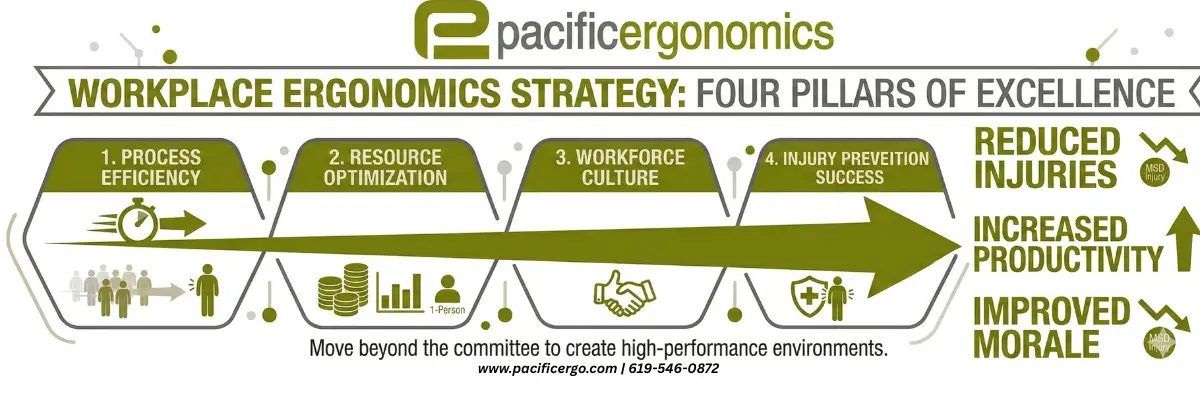
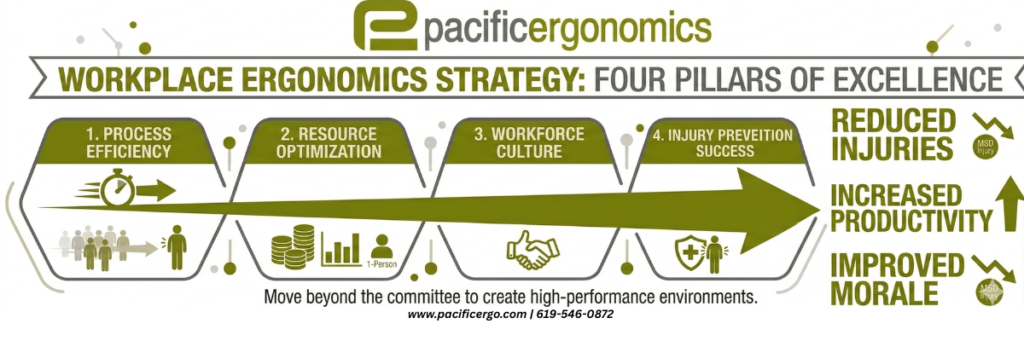
To move from a marginal program to one of excellence, we implement an effective Workplace Ergonomics Strategy for our clients built on four pillars:
1. Process Efficiency: Eliminating Friction
- We dismantle the administrative bottlenecks that leave employees waiting months for support. By streamlining the stakeholder chain, we move organizations from “Risk” to “Resolution” in days not months. While a 3-to-6-month wait is the industry norm, our experience has shown a better way which restores employee trust.
2. Resource Optimization: Financial Integrity
- We ensure your program makes financial sense. With the correct process, systems, and tools, you don’t need eight employee resources involved per assessment. We eliminate the “hidden labor costs” of the 8-person stakeholder chain, allowing your internal teams to focus on their core work.
3. Workforce Culture: The Human ROI
- Proactive ergonomics programs done well significantly increase job satisfaction, productivity and employee retention (Human Factors and Ergonomics Society). When a program shifts from a slow, bureaucratic hurdle to a streamlined, supportive process, it builds a culture where employees feel valued, resulting in measurable increases in productivity. (Human Factors and Ergonomics Society, via ScienceDaily)
4. Injury Prevention Success: The Strategic Result
- True success from a health and safety standpoint is the injury that never happens. By intervening with proactive prevention and/or at the point of early discomfort through strategic design and consultative procurement, injury prevention becomes a natural, documented byproduct of your operational excellence
When a system is designed this way, injury prevention happens as a natural byproduct. However, when a company focuses solely on “managing risk,” they often build the very thing that is currently paralyzing corporate America: a bureaucratic nightmare.
Conclusion: Efficiency is the New Workplace Ergonomics Corporate Wellness Strategy
The goal of an ergonomic program is to help your people thrive, be productive, and increase morale, not just prevent injuries. If your employees are waiting months for a solution that should take a week, and if you have 6-8 employees spending hours of time with every ergonomic assessment request, and your average time to help employees is 1-6 months, your process is working against your business. It is time to move past the spreadsheet, cut the red tape, and build a strategy where high-performance and well-being are the standard, not the exception.
About Pacific Ergonomics:
Pacific Ergonomics is a nationwide provider of leading-edge ergonomic programs and consultative turnkey office furniture and lab furniture solutions. We specialize in engineering the systems that allow companies to support their people with productivity and health, from high-intensity laboratory environments to complex custom solutions to 1000 workstation corporate headquarters.
Our approach is deeply consultative. Whether we are specifying, procuring, and installing a large-scale corporate build-out or supporting a hybrid workforce through virtual ergonomic assessments or lab ergonomic assessments, we ensure that every ergonomic option is presented and optionally integrated at the outset. We believe in doing it right the first time by ensuring solutions are streamlined, financially sound, and tailored to solve the unique operational hurdles your business faces. By dismantling the administrative friction that slows down progress, we move organizations toward high-performance environments with speed and precision.
Sources & References
WorkCare (2025): Workplace Injury and MSD Economic Impact Report
ScienceDaily / HFES: Impact of Ergonomics on Employee Retention and Job Satisfaction
National Research Council: Economic Burden of Musculoskeletal Disorders