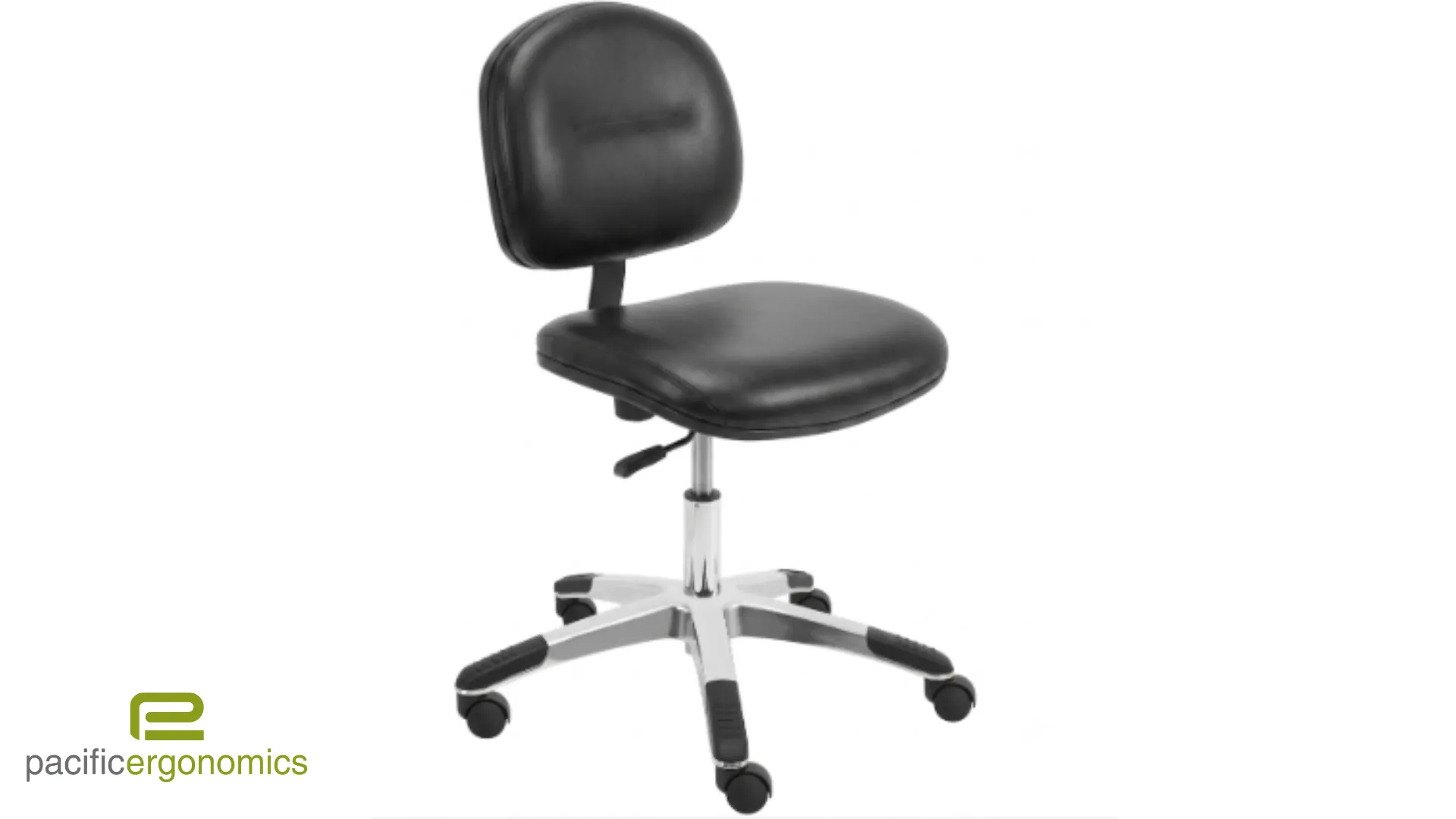


Cove ESD Chair- Petite
Cove ESD Chair Petite: A Precise Fit for Smaller Frames
The Cove ESD Chair solves a fit problem most static-safe seating ignores: a lower 16″ minimum seat height option, and a 17″ seat depth that let smaller-frame operators sit with feet flat, back supported, and forearms level at the bench. It grounds through five conductive casters instead of a drag chain, measures 1.2 to 7.8 million ohms at every test point, and carries a 10-year warranty on the ESD performance itself.
Pacific Ergonomics has specified ESD seating for over two decades. Before you buy, we confirm the Cove matches your operators, your bench heights, your ergonomic requirements, and your grounding program under ANSI/ESD S20.20, so the resistance path is verified, not assumed. Call 619-546-0872 or contact us so we can help you select, procure and install the correctly configured lab chairs for your needs.
For Broader Builds, See the Bay
If part of your team needs more room, look at the Bay ESD Lab Chair with a Wide Seat. It looks nearly identical to the Cove and grounds the same way, with a wider 21.5″ seat, a deeper 19″ seat pan, and a taller 18″ to 23″ height range for larger frames and taller operators. Most facilities order both across a line so every operator gets a correct fit.
Description
A Petite ESD Chair Sized for Today’s Workforce
Most ESD seating starts too high and sits too deep. A typical bench chair bottoms out around 17″ or 18″, which leaves shorter operators perched on the front edge with dangling feet and a loaded lower back. Seat depth causes the same problem from another direction. When the seat pan is too deep, it presses into the back of the operator’s legs, so they slide forward to relieve the pressure and lose contact with the backrest. The result is an operator with no back support all day. With an international workforce, a chair that only fits the 50th percentile leaves real people working this way every shift.
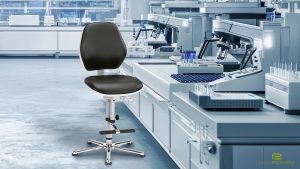
The Cove reaches a true 16″ minimum. The solid aluminum base and single-lever cylinder get the seat low enough for smaller-frame operators to plant both feet and keep forearms level at the work surface. The 17″ seat depth lets shorter operators sit fully back against the 13.5″ backrest without the front edge cutting into their legs, and the waterfall edge takes the pressure off the thighs.
Petite operators get real foot support at every height. The textured pads on the base legs act as a built-in foot rest, so when the seat is raised toward bench height, shorter operators still have a stable place to plant their feet instead of letting them dangle. Feet supported means the lower back stays supported.
Grounded Through the Casters, Not a Drag Chain
Every person on your bench is a static generator. Sitting down, standing up, and shifting in a chair builds charge measured in thousands of volts. An ESD chair has one job beyond comfort: give that charge a continuous path to your ESD floor before it finds a sensitive component.
There are two ways to ground a chair. Some chairs drag a metal chain along the floor. Others run the charge through a conductive base and conductive casters, so the wheels themselves are the ground path. Both can pass a resistance test on day one. They do not perform the same on year three.
This chair grounds through five caster contact points that never leave the floor. A drag chain can lift when the chair rolls over a cord or a floor seam, and it catches debris, wears thin, and sheds particles as it drags. Caster grounding has no moving sacrificial part. The path stays intact every time the chair moves, which is what your auditor’s meter checks under ANSI/ESD S20.20.
The ground path runs unbroken from seat to floor. The seat surface is static dissipative, and every steel component carries a dissipative coating, so charge never hits an insulated dead end on the way down. The result is a chair that measures ESD safe when it is tested, not one that only looks the part.
Budget Friendly, Backed for 10 Years
The Petite Cove is the budget-friendly choice that does not act like one. It delivers a precise small-frame fit, verified caster grounding, and a 450 lb rating at a price most facilities can approve without a capital request. Budget seating usually means compromised seating. This is the exception.
The manufacturer warrants the ESD performance itself for 10 years of single-shift use. That means the static-dissipative properties are covered for the life of the warranty, not just the cylinder and casters. For a single-shift ESD lab chair at this price point, that coverage is uncommon. If your operation runs multiple shifts, talk to us. We carry seating warranted specifically for multi-shift duty and will point you to the right tier.
Use Cases
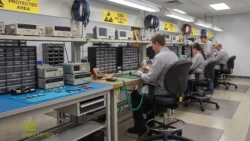
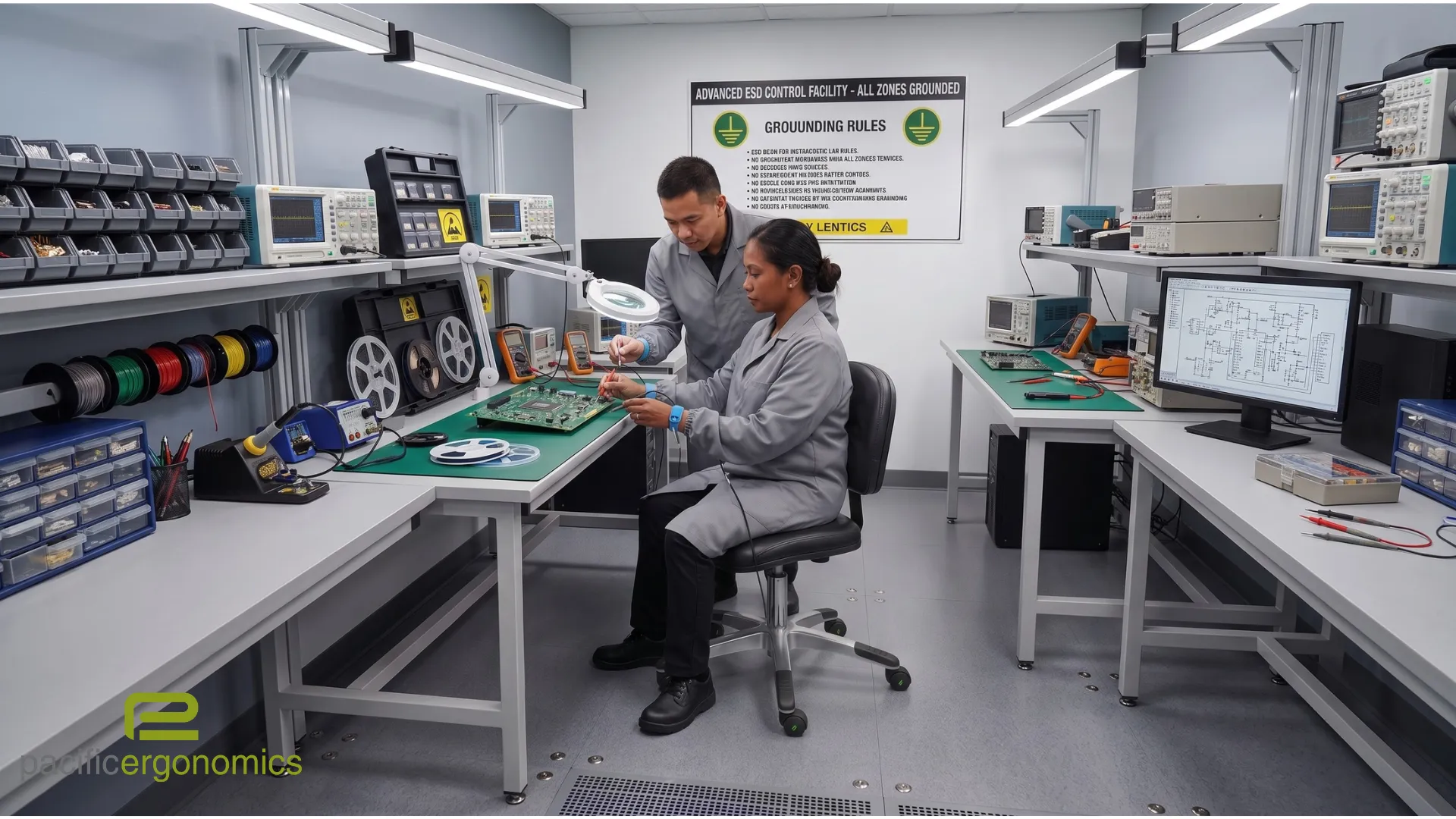
- Electronics assembly and rework benches in ESD protected areas
- Defense and aerospace production floors operating under ANSI/ESD S20.20 programs
- Semiconductor test and inspection stations
- QC and microscopy stations where operators of different statures share the same seat
Explore More ESD Seating and Workstations
Browse our full line of ESD chairs and stools, see our premium ESD chair for multi-shift operations, or pair the Cove with an ESD workbench for a complete grounded workstation.
Frequently Asked Questions
Does the Cove ESD lab chair need an ESD floor to work?
Yes. The chair provides the path from the operator to the floor, and the floor completes the path to ground. It pairs with conductive or dissipative flooring and with grounded ESD floor mats. If your facility has neither, we can spec the matting that completes the circuit.
Will caster grounding pass our ANSI/ESD S20.20 audit without a drag chain?
Yes. Auditors verify a resistance path from the seated operator to ground, not the presence of a chain. The Cove's measured values run 1.2 to 7.8 million ohms at every test point, well inside the 1 billion ohm limit, with five caster contact points that stay on the floor while the chair moves.
Who supplies ESD lab chairs in the United States?
Pacific Ergonomics supplies ESD lab chairs to electronics manufacturers, defense contractors, and research labs across the United States. We are an ergonomic seating specialist, so every chair is specified to the operator, the bench height, and the facility's ANSI/ESD S20.20 grounding program, then shipped and supported nationwide.
How do I choose the right ESD lab chair for my operators?
We start with the operators, not the chair. Measure your bench heights, note the stature range of your team, and count shifts. We will help you through all of this and make it easy. The Cove ESD Lab Chair fits smaller-frame operators with a 16″ minimum seat height and a 17″ seat depth. Pacific Ergonomics walks labs through this fit process at no charge before any purchase.
Does Pacific Ergonomics ship and deliver ESD chairs nationwide?
Yes. Pacific Ergonomics configures, procures, and ships ESD lab chairs anywhere in the United States. We deliver assembled or ship for your facility team to assemble on-site, and we support labs from a single chair to a full floor.
Specs
| Specification | Detail |
|---|---|
| Seat Height Range | 16″–21″ with single-lever pneumatic adjustment |
| Seat Size | 19″ W × 17″ D with waterfall front edge |
| Backrest | 13.5″ contoured back |
| Seat Cushion | 2.5″ quadruple-density foam with memory foam top layer |
| Upholstery | Static-dissipative upholstery, anti-microbial treated, cleans with mild soap and water |
| Base | Polished aluminum five-star base, one solid conductive material with no plating |
| Casters | Five 60mm conductive ESD casters, no drag chain required |
| ESD Performance | Tested to ANSI/ESD STM12.1-2019, S4.1, and STM4.2; all measured points 1.2–7.8×10⁶ ohms against the 1×10⁹ ohm limit |
| Weight Capacity | 450 lb |
| Warranty | 10-year warranty, single-shift use, covering ESD performance |