25 Years of Expertise Serving Nationwide | Showroom by Appt Only: Escondido, CA · Mon–Fri 8:30am–5pm PST |

25 Years of Expertise Serving Nationwide | Showroom by Appt Only: Escondido, CA · Mon–Fri 8:30am–5pm PST |
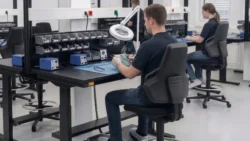
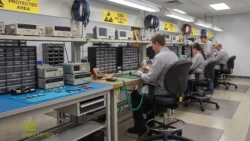
ESD chairs and stools protect your electronics only when the entire seat is part of the ground path, from the seating surface through the base and casters into the floor. Pacific Ergonomics has specified, configured, and installed ESD seating for more than 25 years for electronics manufacturers, defense contractors, semiconductor labs, and ISO-classified cleanrooms nationwide.
We spec the details that decide whether a chair passes an audit. Whether your flooring is ESD rated or the seat needs a drag chain instead or other industry options. Whether the base carries conductive casters. Which cylinder matches your bench heights, from desk height to standing benches. Which seating surface survives your cleaning agents. Every seat we recommend is tested to ANSI/ESD STM12.1 for use in ANSI/ESD S20.20 programs, and many carry ISO 14644 cleanroom ratings from Class 5 to 8.
We confirm the full configuration against your benches, floors, and operators before anything ships. Contact us and we will get every operator in the right seat.
Pacific Ergonomics is hired independently to conduct laboratory , electronic ESD and industrial ergonomic assessments, and that expertise comes with every seating order. We are also hired to help specify, configure and determine the correct ESD seating and configuration for companies all across the U.S. As a certified woman-owned small business, we support diversity spend requirements for government and university buyers. Once your ESD seating is standardized, we set up a dedicated ordering portal with your pricing locked in, so every site orders the same chairs at the same price without re-specifying.
1Flooring and the Ground Path. Chain-free ESD chairs ground through the casters into ESD-rated flooring. Many options and our team will help you find the right solutions.
2Casters Are Part of the Discharge Path. Caster type depends on the base, not preference. Metal bases carry conductive ESD casters. Standard bases need a drag chain instead. Stool heights need casters that lock under load. We spec the right combination for each seat. This also depends on the model and the configuration.
3Bench Height Sets the Cylinder. Every chair ships with the cylinder matched to your actual bench heights. If your benches are electrically adjustable, the seating needs a wider range, and we spec for that.
4Body Sizes Across the Team. One seat size does not fit a whole line. Most facilities mix the Cove for smaller frames and the Bay for broader builds so every operator gets a correct fit.
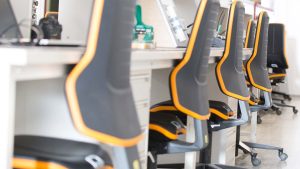
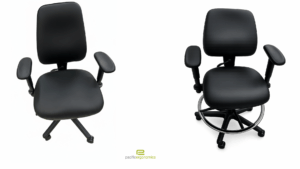
5Chair, Stool, or Both From One Platform. Some lines need both desk-height chairs and bench-height stools. The Nexxit platform builds both ways, so mixed-height floors run one product line with matching protection and parts.
6Cleaning Agents and the Seating Surface. Certain cleaners degrade certain seating surfaces, and cleanroom ESD environments carry both ISO and static requirements at once. We ask what you clean with and what class you run before we match the material.
✓ Electronics assembly and solder lines with shared, multi-shift stations
✓ Defense and aerospace production floors running ANSI/ESD S20.20 programs
✓ Semiconductor and PCB test, repair, and inspection labs
✓ ISO-classified cleanrooms that also require static control
✓ Medical device manufacturing and sterile packaging environments
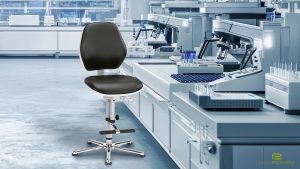
Some rooms ask a chair to do two jobs at once. A cleanroom ESD chair, sometimes called an anti static cleanroom chair, has to hold its ISO class and carry static safely to ground. Both requirements change how the chair is built, and neither one is an add-on.
We specify cleanroom ESD seating as a chair or a stool on the same platform, most often rated to ISO 5. Tighter classes are available when a room requires them, though that combination comes up rarely.
Running the chair and the stool off one platform matters when a room has benches at different heights. Both share the same surface, the same ground path, and the same cleaning tolerance, so your operators work to one standard instead of two.
The cleanroom requirement sets the seat. Depending on the supplier, there are different ways that this occurs. Some solutions have an actual cleanroom chair carries a filter in a sealed under seat shell, and that shell only exists in standard seat shapes. Others have the requirement as their standard chair .
The ESD requirement sets the surface and the path. The seating surface is a textured static-dissipative material rather than a smooth one, so operators stay seated back in the chair through a long shift. Arm caps are static-dissipative as well, and the discharge path runs through the base and casters, with a drag chain where the flooring calls for it.
Your cleaning protocol decides the material. A cleanroom ESD chair gets wiped down constantly, often with isopropyl alcohol several times a day and a sporicidal agent on a schedule. Not every surface holds up to that, and a material that fails under your protocol can void the warranty. Tell us what your team cleans with and we confirm compatibility with the manufacturer before anything is quoted.
If your room is cleanroom only, without the static requirement, see our cleanroom chairs and stools.
ESD stands for electrostatic discharge. ESD chairs are designed to safely dissipate static electricity, protecting sensitive equipment in cleanrooms, electronics labs, and other controlled environments.
Only if your work involves static-sensitive materials or equipment. ESD chairs are essential in electronics manufacturing, semiconductor labs, and cleanrooms. We can help you assess whether your lab requires static-safe seating.
Yes, many of our ESD chairs are also ISO 14644 cleanroom compliant. We offer options for ISO Class 5 to 8 environments, depending on your lab’s specifications.
Conductive materials discharge electricity quickly, while static-dissipative materials discharge it more gradually. Most labs use static-dissipative ESD chairs for safety and compliance with ANSI/ESD S20.20 standards.
Older ESD chairs often rely on a grounding (drag) chain to maintain electrical contact with the floor. Newer designs use built-in conductive components—like casters, cylinders, and static-dissipative materials—to ground electricity through an ESD-rated floor. These newer models meet compliance standards without the need for a chain, as long as they’re used on proper flooring.
Yes. Chairs without a drag chain must be used on ESD-safe flooring—such as conductive or static-dissipative tile or matting—so the built-in grounding system can function properly. If your floor isn’t ESD-rated, a grounding chain is usually required to maintain safe discharge.
Yes. We offer customizable ESD seating options with features like tall cylinders, foot rings, armrests, wipe-down vinyl, and ISO cleanroom compatibility. We’ll help you match the right chair to your team’s tasks, posture needs, and flooring type.
Before you request a single quote, let us understand the business you are furnishing. A short discovery conversation tells us more than any spec sheet, and it is where every Pacific Ergonomics project begins.
"*" indicates required fields