25 Years of Expertise Serving Nationwide | Showroom by Appt Only: Escondido, CA · Mon–Fri 8:30am–5pm PST |

25 Years of Expertise Serving Nationwide | Showroom by Appt Only: Escondido, CA · Mon–Fri 8:30am–5pm PST |
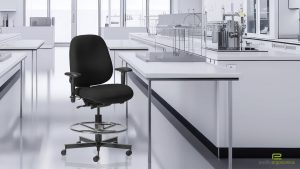
Standard lab seating works fine until it doesn’t, and the failure point is always task-specific. A chair that’s perfect for someone pipetting at a bench for six hours will let a technician slump during a forward-leaning microscope task, and a stool built for occasional use won’t survive a three-shift cleanroom rotation. We specify specialty lab chairs and stools around exactly that problem: the specific posture, task, and duration a piece of seating actually has to support, not a generic “lab chair” that’s expected to do everything. Below you’ll find seating built for active sitting, forward-leaning tasks, cleanroom compliance, pipetting, microscopy, and the kind of heavy daily use that wears out standard furniture fast.
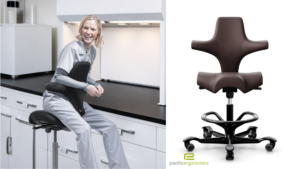
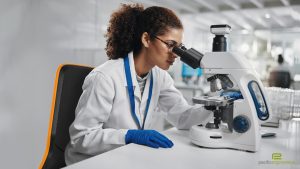
Most lab discomfort doesn’t come from a bad chair. It comes from the right chair being used for the wrong task. A technician hunched over a microscope for hours needs forward tilt and stability, not the same seat that works for someone standing and sitting throughout a shift at a bench. Pipetting work puts repetitive strain on the wrists and shoulders in a way general seating doesn’t account for, which is why a dedicated pipetting stool exists in the first place. Specialty seating solves problems standard chairs were never built to handle.
Specialty lab seating also has to survive the environment it’s used in, not just the task. Cleanroom chairs need materials that won’t shed particles. Multi-shift seating needs to hold up to back-to-back use across different body types and tasks without breaking down after a year. Heavy-duty and big-and-tall options exist because a one-size seat doesn’t actually fit every technician in a lab. We work with facilities and lab managers to match seating to both the task at hand and the conditions it has to perform in every day.
A standard lab chair is built for general-purpose seated work. Specialty seating is built around a specific task or posture, like forward-leaning microscope work, pipetting, active sitting, or cleanroom compliance, where a general chair would create strain or fail to meet the environment’s requirements.
A forward-leaning stool supports a tilted-forward posture that’s common in tasks like microscopy or close benchwork, where leaning forward for long periods on a standard chair would strain the back and neck.
Pipetting is repetitive and puts strain on the wrists, shoulders, and back over time. A pipetting chair is built to support that specific motion and posture, reducing the repetitive strain that comes with hours of pipetting on general seating.
Cleanroom chairs use materials and construction that minimize particle generation and shedding, which is required to maintain the air quality standards a cleanroom depends on. Standard lab chairs typically aren’t built to meet that requirement.
Yes. We offer big and tall, heavy duty, and bariatric-style options so that seating fits the actual technician using it, not just an average body size.
Chairs built specifically for multi-shift environments use reinforced components rated for continuous use across multiple users and tasks per day, which is different from a standard chair built around a single eight-hour shift.
It comes down to the task and the environment: how long someone sits, what posture the work requires, and whether the space has cleanroom, ESD, or multi-shift requirements. We walk labs through that assessment before recommending a specific chair or stool.
Before you request a single quote, let us understand the business you are furnishing. A short discovery conversation tells us more than any spec sheet, and it is where every Pacific Ergonomics project begins.
"*" indicates required fields