25 Years of Expertise Serving Nationwide | Showroom by Appt Only: Escondido, CA · Mon–Fri 8:30am–5pm PST |

25 Years of Expertise Serving Nationwide | Showroom by Appt Only: Escondido, CA · Mon–Fri 8:30am–5pm PST |
Cleanroom chairs have to hold the class of the room they sit in. Pacific Ergonomics specifies cleanroom chairs and stools across ISO 1 through ISO 9, with over 25 years installing them in pharmaceutical, biotech, semiconductor, and government labs nationwide.
Classification comes from ISO 14644-1, which sets how many airborne particles a cubic meter of air may contain. The standard governs the room, not the furniture inside it, so we specify against the class your room certifies to.
Choosing the correct cleanroom chair takes more than the ISO class. The bench height, the reach and task at each station, how many shifts share the seat, the size range across your team, time of shifts, whether static control is required, and the agents your team cleans with all change which chair is right and how it gets built. We work through these important details with you, then configure the chair so people stay comfortable through a full shift and the postures that lead to injuries never get designed into the job. Call 619-546-0872.
Cleanroom classes come from ISO 14644-1, which sets how many airborne particles a cubic meter of air may contain. ISO 1 is the cleanest. ISO 9 is close to ordinary room air.
Each step allows ten times more particles than the one below it. That is why a chair specified for one class does not automatically work in a tighter one. Many facilities still speak in the older Federal Standard 209E classes, so both are shown below.
| ISO Class | Old FS209E Class | Max Particles ≥0.5 µm per m³ | Where You See It |
|---|---|---|---|
| ISO 1 | No equivalent | Measured at smaller particle sizes | Closed highly regulated cleanroom spaces, not typical in most applications. |
| ISO 2 | No equivalent | 4 | Enclosed wafer handling and transfer systems. |
| ISO 3 | Class 1 | 35 | Semiconductor and precision optics, or enclosed wafer handling and transfer systems. |
| ISO 4 | Class 10 | 352 | Microelectronics, sterile compounding |
| ISO 5 | Class 100 | 3,520 | Aseptic filling, sterile pharmaceutical |
| ISO 6 | Class 1,000 | 35,200 | Support areas around ISO 5 zones |
| ISO 7 | Class 10,000 | 352,000 | Medical device assembly, gowning rooms |
| ISO 8 | Class 100,000 | 3,520,000 | General pharmaceutical and device support |
| ISO 9 | Room air | 35,200,000 | Controlled but unclassified spaces |
Particle limits are the ISO 14644-1 maximums for particles 0.5 µm and larger. ISO 1 and ISO 2 are governed by smaller particle sizes and have no Federal Standard 209E equivalent.
What this means for your seating. The class sets what the chair is allowed to release into the air, which drives the surface material, the construction, and whether a filter shell is required. Tell us the class your room certifies to and we will specify seating that holds it.
Where Cleanroom Seating Actually Goes
We specify cleanroom seating across ISO 1 through ISO 9. Most projects land between ISO 3 and ISO 9, and there is a reason for that. At ISO 1 and ISO 2 the classification is usually held inside an enclosed environment around the tool rather than in a room where people sit, with the surrounding space certified to ISO 4 or ISO 5. That surrounding space is where the seating goes.
If you are specifying into an ISO 1 or ISO 9 environment, we have solutions for it. Tell us what the room certifies to and what happens in it.
Cleanroom Chairs – Configured for Your Bench Height
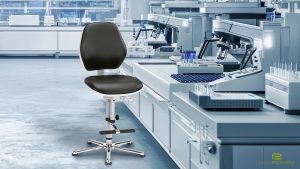
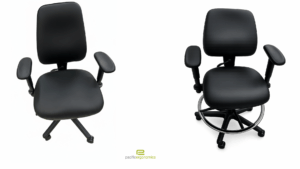
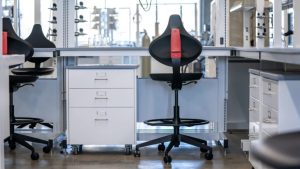
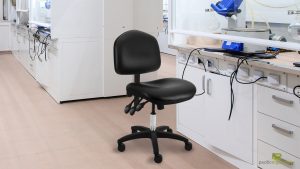
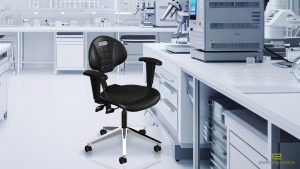
Cleanroom chairs have a backrest and are built for seated work at standard bench or desk heights. Cleanroom stools are height-adjustable across a wider range — they work at both standard and high bench heights and suit tasks where operators move between sitting and perching throughout a shift. If your team works at fixed-height benches and stays seated for extended periods, a chair is the right call. If they move between heights or need to perch while working, a stool gives them that range. Pacific Ergonomics can confirm the right configuration once we know your bench heights.
Cleanroom ESD Chairs and Stools
Some rooms ask a chair to do two jobs at once. A cleanroom ESD chair, sometimes called an anti static cleanroom chair, has to hold its ISO class and carry static safely to ground. Both requirements change how the chair is built, and neither one is an add-on.
We specify cleanroom ESD seating as a chair or a stool on the same platform, most often rated to ISO 5. Tighter classes are available when a room requires them, though that combination comes up rarely.
Running the chair and the stool off one platform matters when a room has benches at different heights. Both share the same surface, the same ground path, and the same cleaning tolerance, so your operators work to one standard instead of two.
The cleanroom requirement sets the seat. A cleanroom chair supports the cleanroom requirement. Often when it is a clean room and a ESD lab, it seems to be ISO 5, but not always. We can support a higher combination of clean room and ESD.
The ESD requirement sets the surface and the path. The seating surface is a textured static-dissipative material rather than a smooth one, so operators stay seated back in the chair through a long shift. Arm caps are static-dissipative as well, and the discharge path runs through the base and casters, with a drag chain where the flooring calls for it.
Your cleaning protocol decides the material. A cleanroom ESD chair gets wiped down constantly, often with isopropyl alcohol several times a day and a sporicidal agent on a schedule. Not every surface holds up to that, and a material that fails under your protocol can void the warranty. Tell us what your team cleans with and we confirm compatibility with the manufacturer before anything is quoted.
If your room is cleanroom only, without the static requirement, see our cleanroom chairs and stools.
Pacific Ergonomics specifies cleanroom chairs and stools across ISO 1 through ISO 9. The right class depends on the room you are certifying to, not on the chair alone, so we match the seating to your documented class rather than to a general cleanroom label.
The ISO classes describe how many airborne particles a cubic meter of air is allowed to contain, under ISO 14644-1. ISO 1 is the cleanest and ISO 9 is close to ordinary room air. Each step up the scale allows roughly ten times more particles than the one below it, so an ISO 5 room permits about ten times what ISO 4 permits. That is why a chair rated for one class does not automatically work in a tighter one.
Yes, and many companies do. Cleanroom seating is built with sealed surfaces and low-particulating construction, which also makes it easy to wipe down and hold up in labs, clinical spaces, and production areas that have no ISO requirement at all.
No. Cleaning agents vary widely in how they affect a seating surface, and the wrong one can degrade the material or void the warranty. We ask what your team cleans with today and how often, then confirm compatibility with the manufacturer before anything is quoted.
Only if the work involves static-sensitive components. Semiconductor, electronics assembly, and medical device production usually need both, and we specify seating that carries an ISO rating and a static path on the same chair. If nobody in the room handles boards or wafers, the cleanroom rating alone is enough. See our ESD seating for the full range.
A cleanroom chair is built not to shed. That means sealed surfaces, non-particulating materials, and a filter housed in a shell beneath the seat. A chair with a smooth, easy-clean surface is not the same thing, because the rating comes from what the chair releases into the air, not from how easily it wipes down.
Yes. The same platform configures as a chair or a stool, with the cylinder chosen to match your bench. Above roughly 23″ of seat height a footring stops being optional, because feet no longer reach the floor.
Before you request a single quote, let us understand the business you are furnishing. A short discovery conversation tells us more than any spec sheet, and it is where every Pacific Ergonomics project begins.
"*" indicates required fields