25 Years of Expertise Serving Nationwide | Showroom by Appt Only: Escondido, CA · Mon–Fri 8:30am–5pm PST |

25 Years of Expertise Serving Nationwide | Showroom by Appt Only: Escondido, CA · Mon–Fri 8:30am–5pm PST |
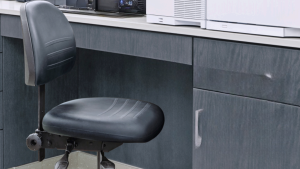
A chair that works fine in a corporate office falls apart fast in a manufacturing facility or lab environment where someone’s sitting through back-to-back shifts, wearing gear, working near sparks or chemicals, or getting up and down dozens of times a day. We’ve specified industrial seating for manufacturing floors, technology labs, cleanrooms, and ESD environments across the country, and the same problem shows up every time: companies buy the wrong chair for the environment and replace it every six months instead of buying the right one once. Here’s what to look for in industrial seating that holds up.
Standard office chairs aren’t built for industrial environments. Here’s where the difference actually matters:
Multi-shift durability. Industrial seating often runs 24/7 across two or three shifts with different users every rotation. Chairs need components rated for that level of continuous use, not just an 8-hour office day.
Warranties that match the use. Most standard chairs carry a warranty built around single-shift use. Industrial chairs should come with warranties that reflect how hard they’re actually going to work.
Materials built for the environment. A manufacturing floor has sparks, grease, and chemicals. A cleanroom has strict hygiene requirements. A technology lab needs ESD control. The chair has to match the environment, not just look heavy-duty.
Intuitive adjustment. In a busy environment, employees won’t stop to read an adjustment guide. Self-adjusting and easy-to-use options matter more in industrial settings than anywhere else.
Prevention over reaction. Most companies don’t think about ergonomic seating until injury claims start coming in. A chair that fits the task and the body from day one costs less long-term than the alternative.
Manufacturing Facilities
Heavy-duty seating built to handle sparks, grease, chemical exposure, and the physical demands of production work across multiple shifts.
Technology Labs and ESD Environments
Specialized seating with electrostatic discharge control for sensitive electronics assembly and testing environments where a standard chair can damage equipment.
Cleanrooms
ISO-rated seating built to minimize particle generation and hold up to frequent cleaning with disinfectants and harsh cleaners.
We take a consultative approach, which means we look at the actual environment, the tasks being performed, and who’s sitting in the chair before recommending anything. Industrial seating isn’t a catalog purchase. The wrong choice for your environment creates the same problems as no choice at all.
Pacific Ergonomics specifies, procures, and installs industrial seating for facilities across the U.S. Contact us for a free consultation, and let’s find the right seating for your floor.
Industrial-grade seating uses reinforced components, heavier cylinders, and materials rated for continuous multi-shift use, chemical exposure, or ESD environments. It’s built to a different standard than office seating because the conditions it operates in are fundamentally different.
If your facility handles sensitive electronics, semiconductors, or PCB assembly, you likely need ESD-safe seating. Standard chairs can generate static discharge that damages components. ESD chairs are built to safely dissipate that charge.
Cleanroom chairs use materials that minimize particle shedding and hold up to frequent disinfectant cleaning. They’re rated to ISO standards that standard industrial chairs don’t meet.
A chair running across two or three shifts per day accumulates wear much faster than one used for a single 8-hour shift. Industrial chair warranties should reflect that actual use cycle, not a standard office assumption.
It depends on the chair. Some industrial chairs are built specifically for shared use with intuitive adjustment so different users can find a comfortable position quickly. Others are better matched to a single assigned user. We help you figure out which fits your workflow.
Proactively. By the time injury claims or workers’ comp costs show up, the chair has already failed. The right seating from the start costs less than the reactive version.
Before you request a single quote, let us understand the business you are furnishing. A short discovery conversation tells us more than any spec sheet, and it is where every Pacific Ergonomics project begins.
"*" indicates required fields