
Commercial Grade Furniture – What Businesses Need to Know
Commercial grade furniture is built to hold up to daily use by many different people over years of service, and it’s tested and warrantied to prove it.
Commercial grade furniture and the furniture you buy for your home can look alike on the showroom floor. They’re built for very different jobs.
We’ve seen what happens when a company buys the wrong type. Pacific Ergonomics has furnished corporate commercial offices, labs and company spaces at companies all over the U.S.
Here’s what sets commercial furniture apart, where companies go wrong trying to save a few dollars, and how to buy the right thing once instead of twice.
Commercial Grade Furniture Is Built for Many People, Not One Household
At home, you buy for the people who live there. If you live alone, you buy for yourself. A couple buys for the two of them, a family buys for the family. A household changes slowly, and when it does, say you go from three kids to four, you often just move to a bigger house.
A business is fluid all the time. The employees you have now can change. You can grow, expand or see turnover, and the furniture has to support all of it. That’s why so many companies choose modular offices and furniture that reconfigures as the team changes.
Commercial furniture is sized for the 90 percent. The same chair or desk has to work for everyone who uses it, tall, short, large and small. You’re buying for whoever uses the space now and next, not one known household.
Sizing and Configuration
Commercial lines come in many sizes and modular pieces, so a space can be planned to fit the room and seat everyone comfortably while still looking right. A hotel or corporate lobby needs pieces scaled to a large public space. A home sofa is sized for one living room.
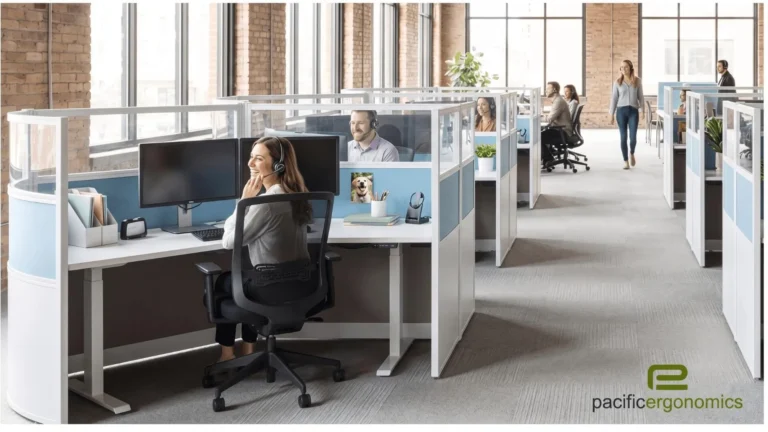
Some commercial products don’t exist in the home world at all. Modern office cubicles, for example, are built for teams, power, storage and privacy in ways no home store carries.
Buying for the Role, Not the Person
Take a height-adjustable desk. For a workplace, you want one with a full height range so it fits whoever sits there. At home, depending on your height, that range may not matter. Multiply that by a hundred other decisions when the furniture is shared.
Turnover means the next person inherits that desk or chair. Commercial furniture is built with the range and durability to fit whoever comes next.
The Aesthetics Are Doing Another Job
At home, you design around your own taste. Picture fifty houses on one block and you’d find fifty different styles. Some transitional, some modern, some furnished with grandmother’s pieces, and everything in between. A home is supposed to fit the person who lives there.
A workplace works differently. Commercial design serves the brand and has to appeal to most of the people in that office. You’re designing for the people connected to that business:
- The employees who want to work there
- The clients and visitors who form an impression of the company
- The shareholders and partners invested in it
What to Look for in Commercial Office Furniture
- A look that carries your brand, with colors and finishes that fit your identity
- Consistency across the space, so it reads as one planned design
- Finishes that stay sharp under daily use and cleaning
- Styles broad enough to suit the range of people who work there
- A design that still works as you grow or reconfigure
- Comfortable for people of all sizes, with ergonomic considerations where they matter
The Goal of the Furniture Is Different
At home, the goal is rest. You want a space that feels soothing, somewhere to unwind in front of the TV.
At work, the furniture has a job to do. The space should feel energizing and on brand, a place where people do good work and visitors leave with the right impression.
What Happens When You Skip Commercial Grade Furniture
Trying to save a few dollars on furniture that isn’t built for the workplace usually costs more in the end. Here are three situations we see again and again.
Online Office Chairs
A small office buys task chairs online. No warranty, no service, and they aren’t comfortable. The first part to go is usually the cylinder, and on a cheap chair it can’t be replaced.
The seat sinks, and posture sinks with it. The employee spends the day in an awkward position, one of the known causes of work-related musculoskeletal disorders. Some people work in pain. Others quietly put up with it until someone finally speaks up.
Then you buy chairs twice. You replace everything with commercial ergonomic chairs, after paying for the discomfort in between. And when the cheap chair breaks, there’s no one to call. No rep, no warranty, nothing you can do. An ergonomic assessment catches these problems before they turn into injuries.
Home Patio Furniture for a Business
This is one of the most common places companies try to save. During an office design, someone suggests picking up patio sets at a warehouse club or online. That furniture was made for a backyard used now and then.
A business courtyard gets daily traffic and daily weather. Home patio pieces fade, rust and fall apart fast. Commercial outdoor seating is made to be cleaned and sanitized, can be secured so it doesn’t walk off, and is built to last outdoors.
Outdoor spaces need space design too. A commercial patio has to fit the area, flow for the people using it and meet code, the same as any room inside.
Home Desks in an Executive Office
A home office desk is built for paying bills, maybe half an hour or an hour a day. It isn’t designed for eight hours of real work.
Many are set up wrong for the body. They’re often too high, and a very common problem is a pencil drawer running under the whole desktop. It blocks your legs and armrests, so you can’t raise the chair to the right height or pull in close. You end up working with your arms and shoulders in an awkward position all day.
They also miss what an office needs. Executive office furniture is made to be cleaned, built to last and designed to be worked at all day, comfortably.
Where Commercial Really Separates From Home
Space planning. Designing a home involves planning too, but the goals are different. At home you plan around one household’s taste and comfort, and there’s room for emotion. Someone might splurge on a painting that doesn’t make financial sense because it makes them happy.
Commercial design and procurement runs on a budget, so a lot of that emotion comes out of it. Every choice is measured against how the space works: the right sizes for the room, aesthetics that carry the brand, ADA access and code compliance. Buy furniture first and drop it into an office, and it won’t work well no matter how good each piece looked. That’s why every project starts with commercial office space planning.
Professional installation. Commercial installers know the industry lines and install them all the time, and commercial furniture is designed for a fast, repeatable install. A home product is a pile of parts nobody has seen before, often with complicated assembly. Even a pro is slower figuring it out, so the install can cost more with home furniture, not less. Our commercial furniture installation team handles the full job, start to finish.
How Long Does Commercial Grade Furniture Last?
Commercial Grade vs. Home Furniture at a Glance
Typical service life and support under daily commercial use
| Commercial Grade | Home / Online | |
|---|---|---|
| Task chairs | 7 to 12 years | Often little to no warranty |
| Height-adjustable bases | 5 to 12 years | Often little to no warranty |
| Workstations and systems furniture | 15 to 20 years | Not built for daily commercial use |
| Warranty | Often 10 to 12 years, included | Extended warranty sold separately, if offered |
| Support and service | Factory-trained technicians who specialize in commercial furniture | No install or service team behind it |
Typical ranges under daily commercial use. Actual lifespan varies by product and manufacturer. Source: Pacific Ergonomics, based on 25 years of specifying and installing commercial furniture.
How to Tell If Furniture Is Commercial Grade
Before you buy, look for these signs:
- A written commercial warranty that covers daily business use
- Replaceable parts, like chair cylinders and casters
- Testing to industry standards such as BIFMA
- A stated weight rating
- Fabrics and finishes made to be cleaned often
- A dealer and technicians who service it after the sale
Commercial Grade Doesn’t Have to Break the Budget
The goal is the right fit for your budget. Commercial lines come at many price points. A needs analysis sorts out where to invest, like the chairs people sit in all day, and where a simpler piece works fine.
What You Can Bring in From Home
Some home pieces work well in an office. The decorative, low-use items can add warmth while the working furniture stays commercial grade:
- Art, though corporate art tends to be larger and more abstract to suit big walls and a broad audience
- Plants and planters
- Table and floor lamps
- A rug in a low-traffic spot
- Personal accents in an executive office
The rule of thumb: decorative and low-use is fine from the home side. Anything people sit in, work at or walk across all day should be commercial.
Buy It Right the First Time
We start with how your people work, plan the space and specify commercial grade furniture that fits your goals and your budget.
Let’s Talk About Your Business Goals →Commercial Grade Furniture FAQ
What makes furniture commercial grade?
Commercial grade furniture is built and tested for daily use by many different people over years of service. It typically carries a written commercial warranty, uses replaceable parts, meets industry standards like BIFMA and uses fabrics and finishes made to be cleaned often. Home furniture is designed for lighter use by one household.
Is commercial grade furniture worth it?
Yes, for anything people sit in or work at every day. Home furniture often fails within a year or two of commercial use, so you end up buying twice. Commercial furniture lasts longer, comes with real warranty support and has someone to call when a part needs service.
How long does commercial grade furniture last?
Under daily commercial use, commercial task chairs typically last 7 to 12 years, height-adjustable bases 5 to 12 years, and workstations and systems furniture 15 to 20 years. Many commercial warranties run 10 to 12 years. Actual lifespan varies by product and manufacturer.
What’s the difference between lounge furniture from a furniture store and commercial lounge furniture?
Furniture store lounge pieces are built for a living room and a few hours of use a day. Commercial lounge furniture is built for a lobby or break room where people sit down and get up all day, with stronger frames, higher-rated foam and fabrics tested for heavy wear. Commercial pieces also come in more sizes, so they can be scaled to a large public space.
Do companies need commercial grade furniture for employees who work from home?
Yes, we highly recommend it. Commercial furniture holds up to a full workday, gives every employee the same quality setup and meets ergonomic standards, like a desk with the correct height range and a quality chair. Without it, you don’t know what employees are buying on their own, and a lot of it puts them at risk. A virtual ergonomic assessment shows you what each person is working with.
Can you mix commercial and residential furniture in an office?
Yes, for decorative and low-use pieces. Art, plants, lamps and a rug in a low-traffic spot can come from the home side. Anything people sit in, work at or that takes daily traffic should be commercial grade.