Sustainable Office Furniture Decommissioning: 8.5 Million Tons Go to Landfills Every Year. There Is a Better Way.
Every year, 8.5 million tons of office furniture end up in landfills across the United States. That number comes from the Environmental Protection Agency.
It costs American businesses over $450 million annually just in landfill tipping fees.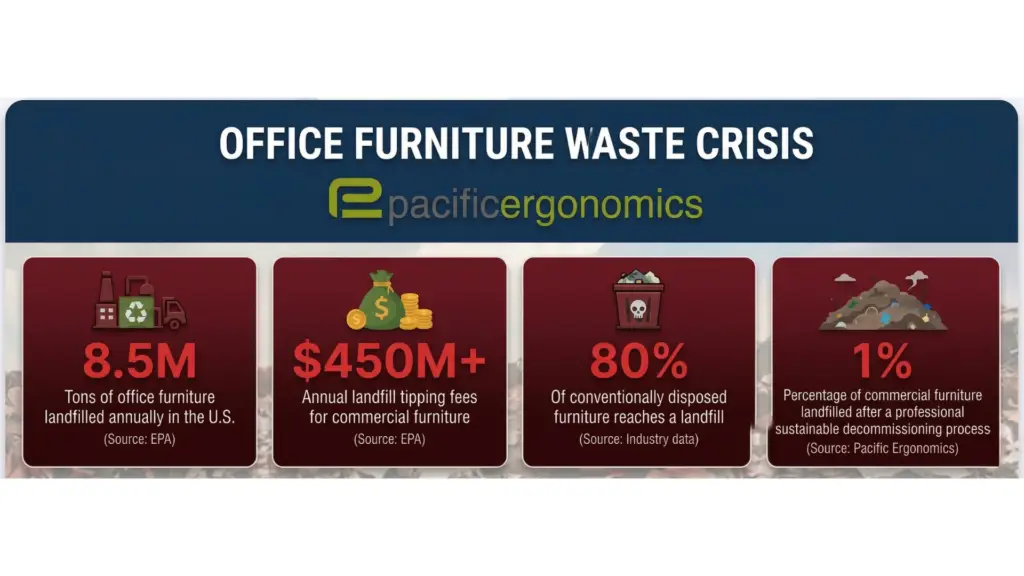
Let that sink in………………80% of decommissioned commercial furniture goes straight to a dump. This is staggering.
Why Companies Upgrade Their Furniture (And Why They SHOULD)
Here is something worth saying out loud: upgrading your corporate office furniture is a good business decision as an executive decision. Not a wasteful one. Not an indulgent one. A smart one.
If you kept wearing clothes from the 1960s into the 1970s, you would not make a great impression in a job interview. The same principle applies to your workspace. Outdated, worn, mismatched furniture, or uncomfortable furniture that is hurting your team tells your employees and your clients a story about your company. That story is not the one you want to tell. You want to show them you care about their well being by your actions.
Research backs this up.
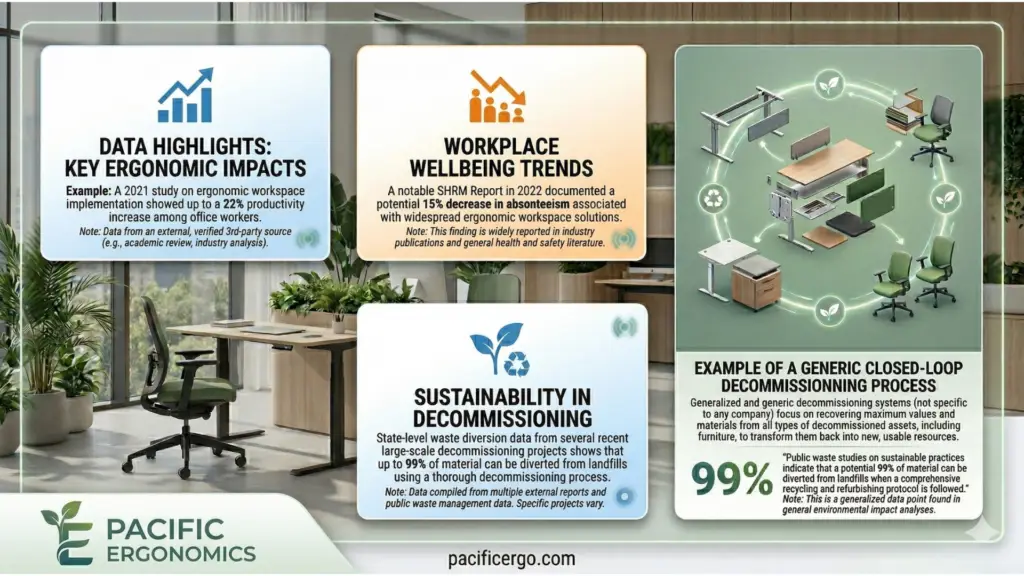
- A 2023 Harvard Business Review study found that employees using modern ergonomic furniture showed a 22% increase in task completion speed.
- A 2023 SHRM report found that companies investing in ergonomic workspace solutions experienced 15% lower absenteeism rates.That percentage adds up quickly. Workspace quality directly impacts productivity, morale, and retention.
Upgrading your workspace is an investment in your people and your business. The question is not whether to upgrade. The question is what happens to the furniture you are replacing.
The Problem: Conventional Office Furniture Disposal
When most companies plan an office renovation, relocation, or furniture refresh, the conversation centers on the new space. The new layout. The new furniture. The energy of a fresh start.
What happens to the old furniture? For most companies, the default answer is a junk removal service. A truck shows up. Everything gets loaded. It goes to a landfill.
Maybe the hauler pulls out a few high-value pieces to resell. But the overwhelming majority of it gets buried. Functional chairs. Solid conference tables. Steel filing cabinets with decades of life left. All of it taking up space in a landfill, decomposing over the next century.
The numbers tell the story:
- 8.5 million tons of office furniture reach U.S. landfills every year (EPA)
- Over $450 million spent annually on landfill tipping fees for commercial furniture
- 80% of conventionally liquidated office furniture ends up in a landfill
- Less than 20% gets resold. Nothing else is recovered.
This is what conventional disposal looks like. And it is completely avoidable.
A New Way for Companies to Decommission their Office Furniture- Donate to Non-Profits
With our partnerships, twenty-nine percent of decommissioned furniture goes directly to nonprofit organizations. Not into a warehouse. Not onto a resale lot. Into the hands of organizations doing work that most people never see.
Think about what that means.
- Your old office chairs go to a program that serves homeless youth who have aged out of the foster care system. Kids who have never had a stable home, who are trying to finish school from a community center with folding chairs and card tables. Now they have real workstations. A place that feels like it was built for them. A place that says: someone thought you deserved better than this.
- Your conference table goes to a domestic violence shelter. A program helping women rebuild their lives from nothing. Women who left everything behind to be safe. Now they have a real meeting space for job readiness workshops, legal aid consultations, and the planning sessions that help them build a second chance.
- You upgrade your company to modern office cubicles and your outdated cubicle workstations are so appreciated at a foster youth aging out of the system at 18 program. Kids who have never had parents, who have no safety net, who are expected to figure out careers with zero resources. Now they have a real training environment with real office furniture, learning real skills at a real desk. Not a hand-me-down folding table in a church basement. An actual workspace that tells them: this is what a professional environment looks like, and you belong in one.
- Your lab stools go to a community college science program that could not afford to replace broken equipment. Students who chose the affordable path to a degree, who deserve the same quality lab experience as students at a university ten times the price.
This is not abstract. This is not a bullet point on an ESG report. This is furniture that had one life in your office and gets a second life changing someone else’s.
When companies choose sustainable office furniture decommissioning, they are not just keeping furniture out of a landfill. They are directly funding the physical spaces where people rebuild, where kids learn, where second chances happen. And they probably have no idea how much that matters to the people sitting in those chairs.
Overview of Sustainable Office Furniture Decommissioning:
Sustainable office furniture decommissioning treats your old furniture as a resource, not waste. Every item is evaluated and directed to its highest and best use. The goal is simple: keep everything possible out of a landfill.
Imagine, what isn’t useful to your company, is GOLD to another, and it helps our planet. Commercial furniture recycling helps our planet, helps people who need it and will appreciate it, and everyone wins.
Here is how it works with Pacific Ergonomics for our clients that want to participate.
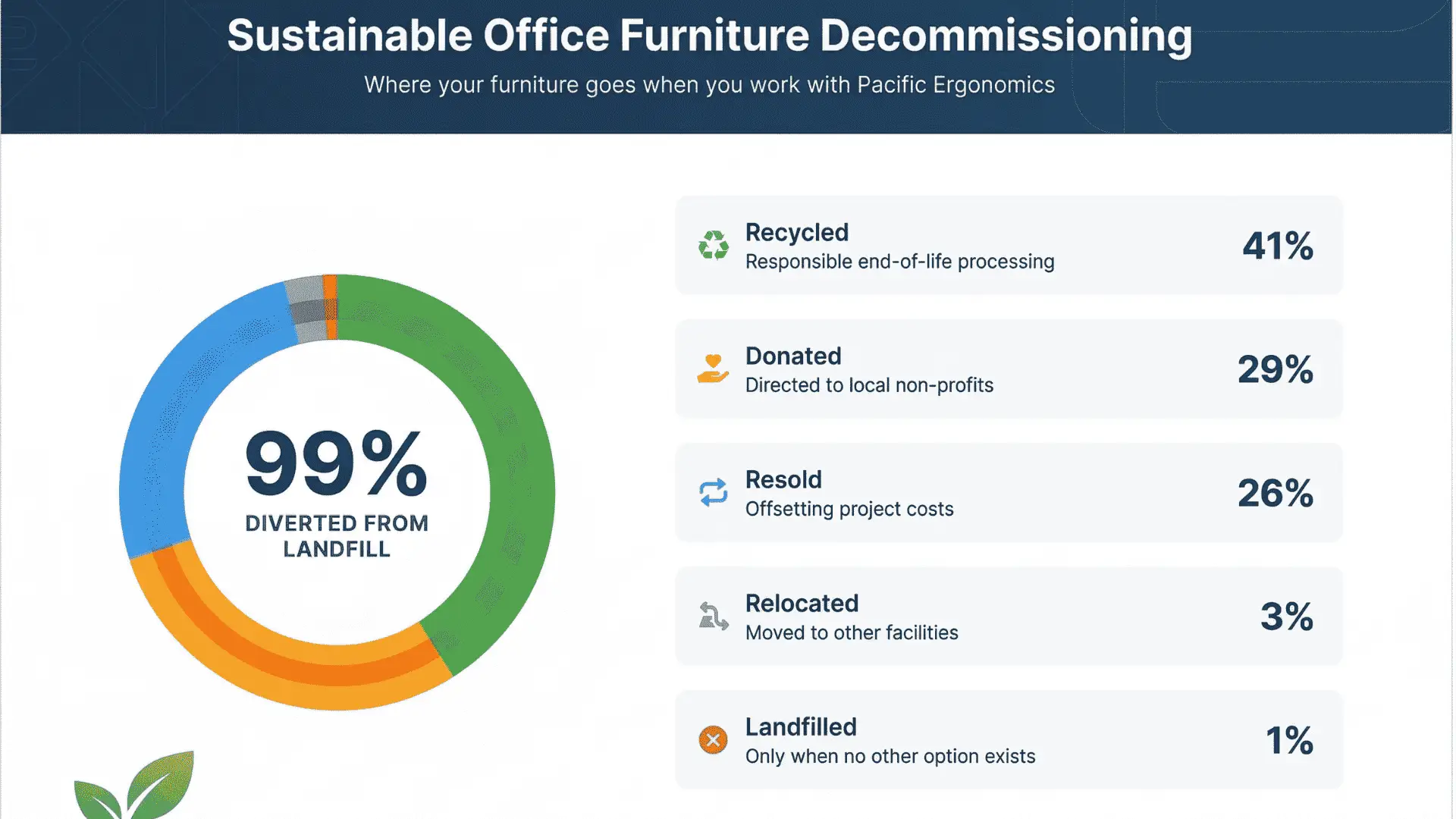
Recycled (41%). Materials at end of life are broken down and processed responsibly. Steel becomes new steel. Plastics get reprocessed. Textiles get diverted. Nothing recyclable goes to waste.
Donated (29%). Furniture with remaining useful life goes directly to nonprofit organizations and community groups. Schools that need desks. Churches that need chairs. Shelters that need everything. Your old conference table becomes someone else’s meeting room. Your workstations help a nonprofit that is doing real work in the world. Companies can be a direct part of that.
Resold (26%). High-value items in good condition enter the secondary market. This offsets the cost of your decommissioning project and gives the furniture a productive second life.
Relocated (3%). Some items move to other facilities within the same organization.
Landfilled (1%). Only when no other option exists. Less than one percent.
Compare that to 80% under conventional disposal.
The Tax Benefits Are Real for Office Furniture Decommissioning
Here is something many companies do not realize: donating office furniture to qualified nonprofit organizations is tax-deductible.
Under IRS guidelines (Publication 526), businesses can deduct the fair market value of furniture donated to 501(c)(3) organizations. This applies to C-Corporations directly on their corporate returns and passes through to owners for S-Corps, LLCs, and partnerships.
This means companies upgrading their workspace can potentially benefit twice: deducting the new furniture purchase under Section 179 (2026 limit: $2.56 million) and deducting the fair market value of the furniture they donate through sustainable decommissioning.
Your tax advisor can confirm the specifics for your situation. But the opportunity is real and significant, especially for larger projects.
The environmental impact report you receive at the end of the project documents every item donated, to which organization, and at what value. That documentation supports your tax deduction and your ESG reporting.
What You Receive for Donating and Waste Reduction of Office Furniture
A turnkey process. When we design, procure, install office and laboratory furniture, we have an option to also help manage the entire removal logistics. Pickup, sorting, routing to recycling, donation, and resale channels. Your facilities team does not have to manage it.
An environmental impact report. Every sustainable office furniture decommissioning project produces a detailed report quantifying your specific impact. CO2 diversion. Waste reduction. Pounds kept out of landfills. Items donated. Materials recycled.
This is not feel-good data. It is documentation your sustainability team can use for ESG reporting, corporate social responsibility communications, shareholder reports, and internal environmental goals. Companies are publishing these results publicly. They should. It demonstrates genuine commitment and gives other companies a model to follow.
Cost offset through resale. High-value items generate revenue that reduces the overall project cost. The better condition your existing furniture is in, the more the project pays for itself.
Sustainable Lab Furniture Decommissioning
This service is not limited to office environments with desks, task chairs, cubicles systems and lounge furniture. . Lab furniture decommissioning also follows the same principles. Lab seating, benches, stools, carts, storage units. The same three pillars apply: recycle, donate, resell.
For biotech companies, pharmaceutical labs, research institutions, and healthcare facilities, sustainable lab furniture decommissioning aligns directly with corporate sustainability mandates. Many of these organizations have formal environmental targets. A documented decommissioning program with quantified results gives them real data to report.
Your Workspace Upgrade Benefits Your Business and the Planet
Upgrading your workspace is not wasteful. It is strategic. Modern workspace design drives productivity, supports employee well-being, and signals to your team and your clients that you invest in quality.
And now, the furniture you are replacing does not have to be a liability. It becomes an asset. An asset that helps nonprofits. That generates tax benefits. That keeps 8.5 million tons of waste from growing even larger.
Pacific Ergonomics is a workplace solutions company specializing in ergonomic consulting and commercial furniture projects, from single-office setups to multi-location, complex implementations nationwide. We design and furnish workspaces that support people and business goals. And now, we manage the full lifecycle. New furniture in. Old furniture out. Responsibly.
If you are planning a workspace project, whether it is a full office renovation, a furniture refresh, a lab redesign, or a multi-location rollout, ask us about sustainable decommissioning. We will show you how your project can be good for your people, good for your business, and good for the planet.
Sources: – EPA data on office furniture waste: Resource Recycling Magazine – Furniture waste and landfill costs: Michaels Global Trading – Ergonomic furniture and productivity: Harvard Business Review, 2023 – Ergonomic furniture and absenteeism: SHRM Report, 2023 – IRS charitable contribution guidelines: IRS Publication 526 – Section 179 deduction limits: OnPay